Verify
Device-Model Verification
A test program can compile cleanly, pass every structural validator, and still be wrong — reading the wrong register, comparing against a value the silicon can never produce, measuring supply current in a state the flow never established. ATE·IQ replays the generated program and its patterns against a model of the device itself and catches those errors before the program reaches a tester — the same model your design and verification teams already rely on, plugged into the test side of the house.
Why compile-clean is not correct
Structural checks answer "is this a valid IG-XL program?" They cannot answer "does this program do what the spec asked, to this device?" — the question where real test-floor debug time goes.
The capability was proven the honest way: on a demonstration program for a small SPI temperature sensor — sheets, VBA and cross-sheet checks all clean — the model replay found four independent defect classes, each of which would have surfaced as a confusing failure at the tester.
| What the checkers saw | What the device model found |
|---|---|
| Valid SPI patterns, correct sheet references | No pattern formed the device's 16-bit command word — the part would parse every write as a different operation on a different register than intended. |
| A well-formed shutdown-current test with correct limits | The flow never actually commanded shutdown, so the measurement was taken in continuous-conversion mode — far outside the limit band, on a perfectly good part. |
| A burst-read test that generated and validated | The pattern issued thirteen single reads and never auto-incremented — functionally a different test from the one the requirement asked for. |
| Read compares populated from the register map | (latent, demonstrated rather than observed) Compares pinned to power-on reset values: a converting device returns live data, so a correct part would fail the test the first time the flow actually converted. |
None of those are visible to a compiler, a schema validator or a lint pass. They are meaning errors — and two were fixed structurally in the generator, so the same class cannot recur.
The device model
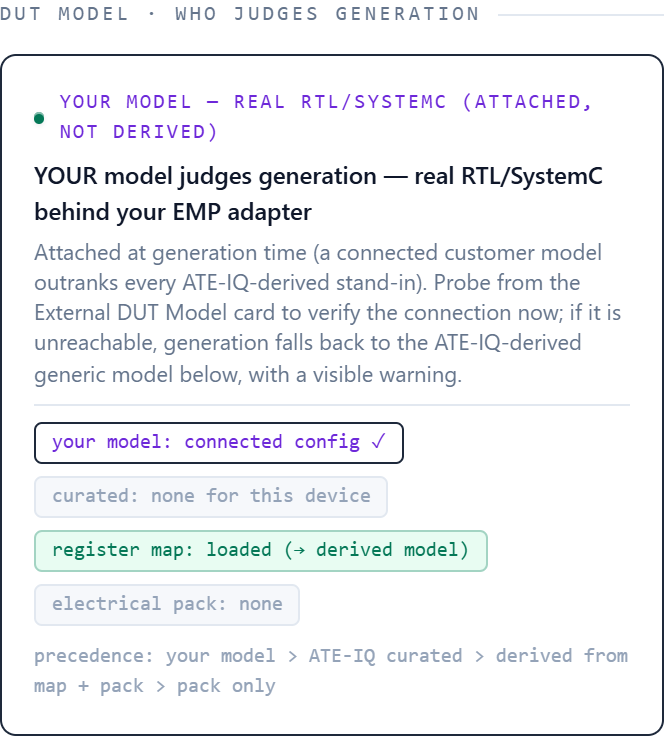
ATE·IQ does not invent the device. The model is an input, behind a small, explicit contract: anything that can answer as the part would can be the judge — and that model usually already exists, built by design and verification long before the test program.
Every verdict is reproducible, and none is issued unless the model first proves itself — what it cannot honestly judge is declined out loud, with no partial credit and no quiet degradation.
The device reads the wire
Verification runs on the real artefacts: the emitted .atp pattern is
read bit by bit and parsed the way silicon would, with no help from its own
annotations. Findings carry expected-versus-actual with units and a location, and
each test starts from a production-realistic condition, not a fresh-from-reset
part.
Where the model comes from
| Source | What it judges |
|---|---|
| Derived from your register map automatic, no modelling work |
Register semantics, judged automatically — everything dynamic declines honestly (§08). |
| A behavioural model built to the contract how the capability was proven |
Full device behaviour — the reference model for the demonstration part was written clean-room from public documentation, every behaviour citing its source. |
| Your own device model connected, not rewritten (§03) |
Your own RTL or SystemC, connected as-is — outranking every derived model, proven on real third-party RTL (§03). |
The fabricated instance
Digital behaviour will not answer an analog question, so ATE·IQ can layer a documented-envelope electrical stand-in over the model — every value carries its provenance into any finding. It unlocks the analog families a register model must decline — continuity, leakage and the like.
Bring your own model — a connection, not a project
The strongest judge is the model your design and verification teams already maintain, connected as-is — your own RTL or SystemC, nothing rewritten, nothing leaving your infrastructure. Proven end to end on real third-party RTL: an SPI flash behavioural model and an open-source I²C slave core, unmodified under an HDL simulator, judging generated programs — one catching a deliberately wrong register value in the project's own map, both values named.
A model that cannot prove itself is refused, with the reason on screen; an unreachable one becomes a visible warning, never a silent substitution.
You always know who judged
A derived stand-in and your actual device model are different authorities, and the platform never lets them blur: every surface states who judged, and the generated program remembers its judge — a stale judge is caught loudly before dispatch.
Start from a standard file
The derived stand-in starts from files you already have. A CMSIS-SVD upload lands the register map ready to drive generation and the generic model — with its one caveat stated plainly: whether SVD's addressing matches your part's serial-bus addressing is a judgement the import cannot make for you. DC facts come from a guided datasheet-transcription editor with live validation — the DC facts become judgeable, each reading carrying its citation.
Cross-checking the judge itself
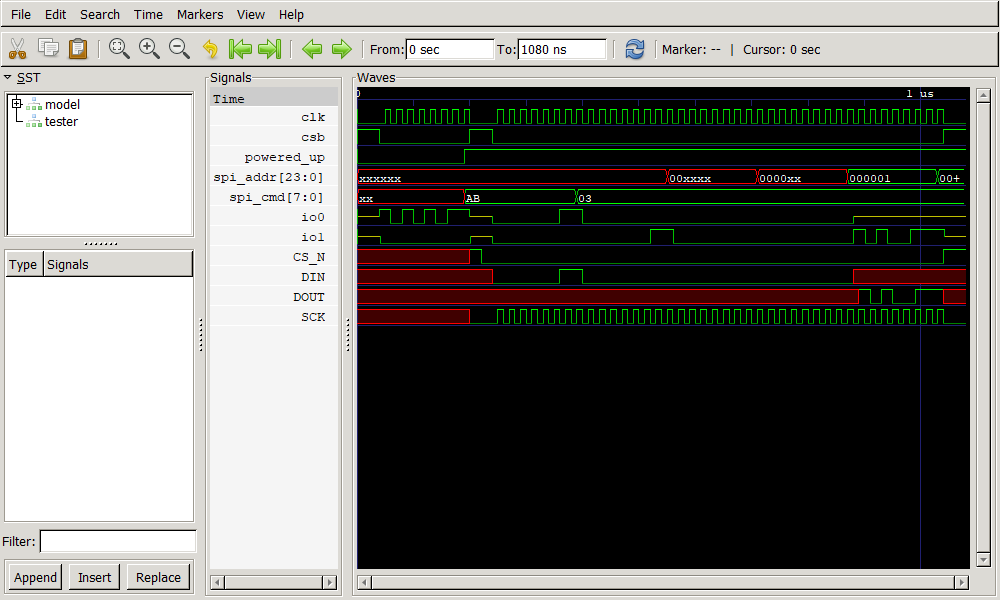
The judge itself is cross-checked against an independent simulator, waveform for waveform: where the connected setup can supply the simulator's own capture, each pattern test ships a cross-check waveform file — the tester's pattern and the simulator's capture, time-aligned in one standard VCD, openable in any waveform viewer — so an engineer can compare raw waveforms with their own eyes, independent of the replay's verdicts.
What it will not judge
Every test ends in one of three explicit outcomes — verified, a located finding, or an honest decline, per test family, with the reason — and a declined check is never counted as a pass. The decline list is calibrated, not defensive: windowed supply-current measurements were declined exactly as long as they were unjudgeable, and became verifiable the moment they were not (§07).
Some families stay declined on principle: timing measurements — the replay is deliberately time-free; repeatability, drift and supply-rejection grades — real silicon statistics that no model stands in for; and checksum-protected frames, which it will refuse rather than guess.
The device model also cannot be satisfied instead of the existing checks: a result is clean only when every judge agrees, and a failed model self-test is never clean, because nothing was verified.
Seeing it: design-verification waveforms
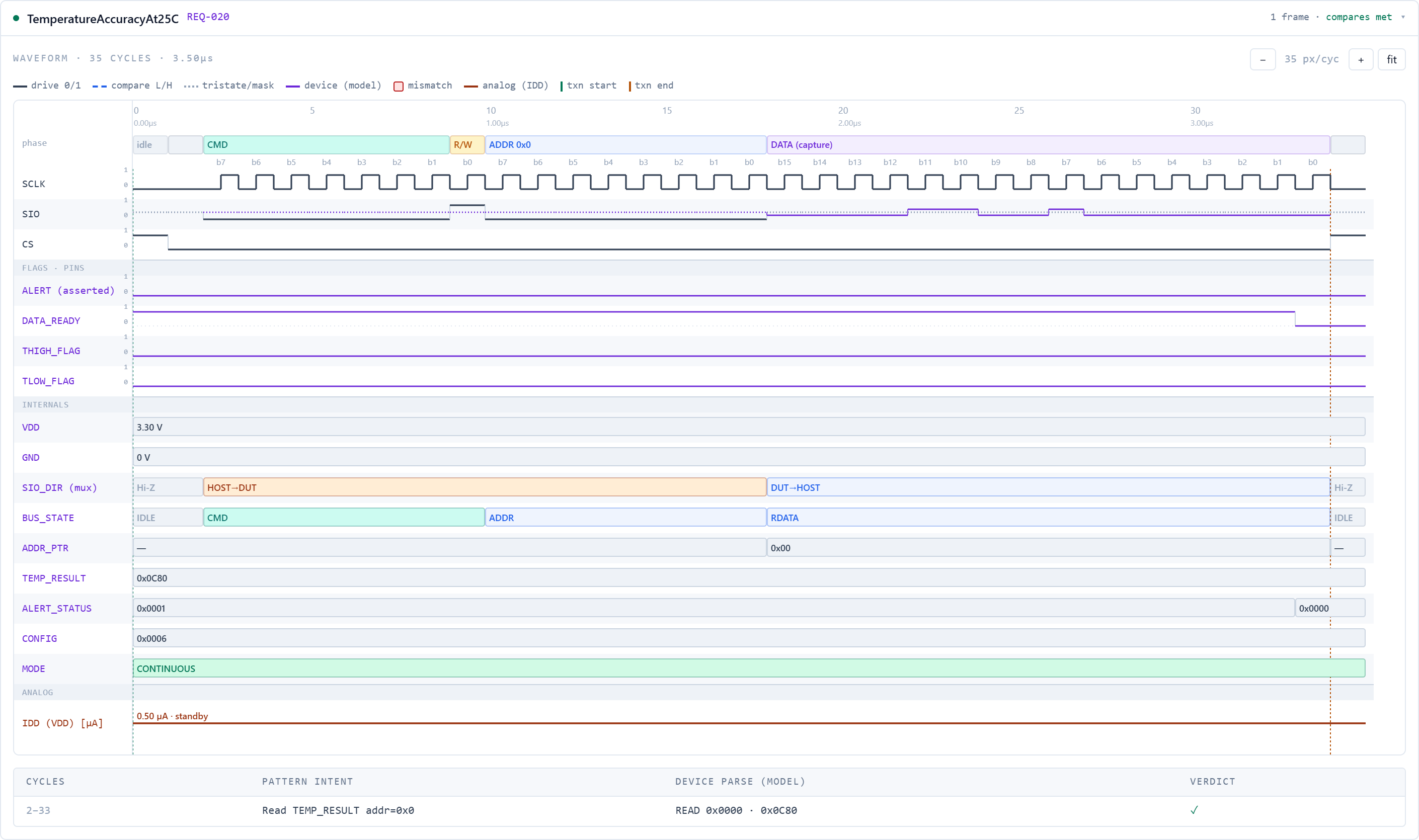
Every pattern-carrying test produces a full DV-style waveform, drawn from the same replay that judged it — the waveform you inspect cannot drift from the verdict: the stimulus the tester will drive, the device's modelled response, the part's internal state, and a frame table of what the pattern intended beside what the device parsed.
Measurements the pattern takes itself
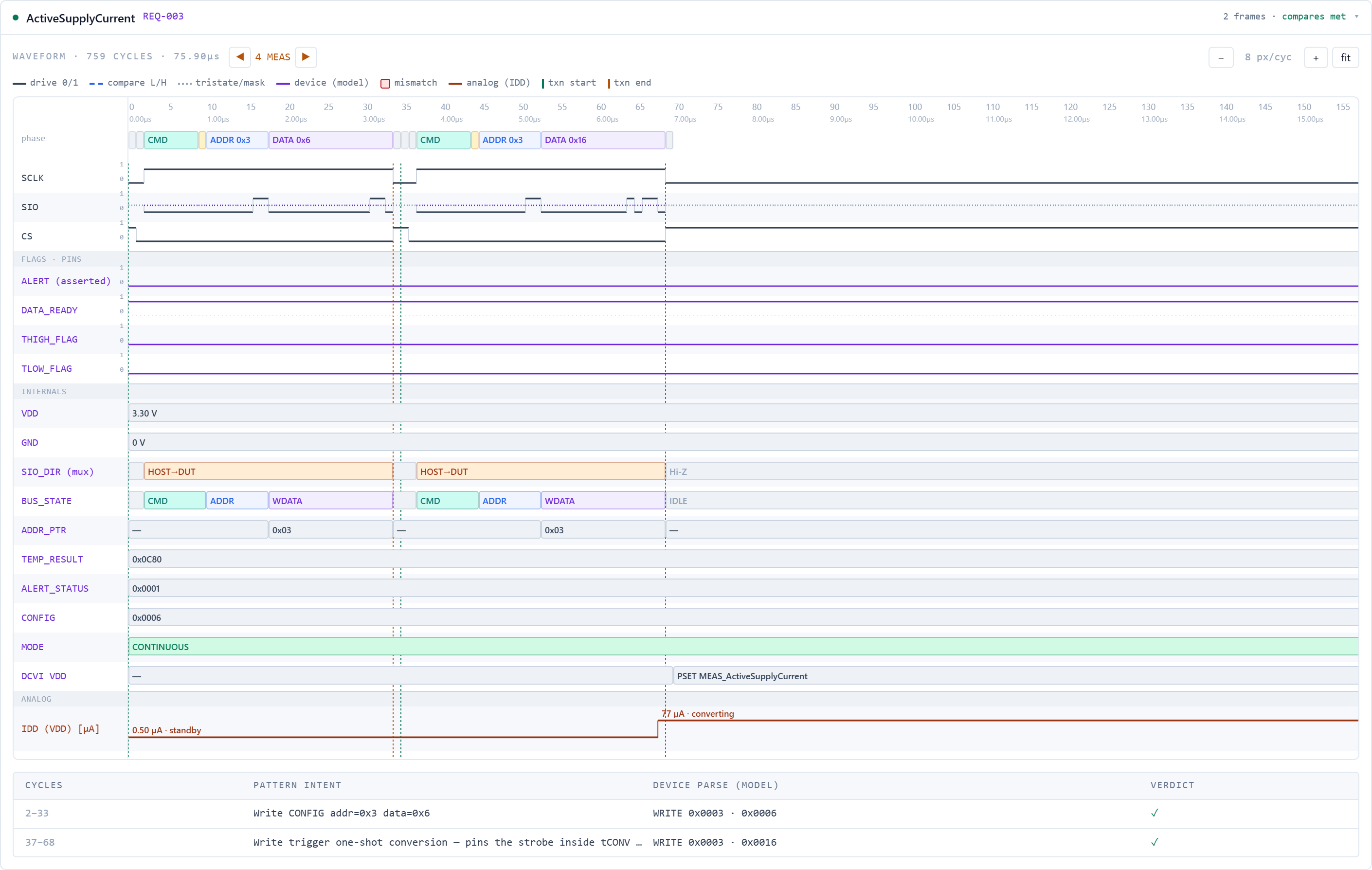
Some measurements only mean something at a precise instant inside a running pattern — a supply current during a conversion, not before or after it. On UltraFLEX the pattern can pin that instant itself; ATE·IQ generates what that takes and verifies it, judging each sample against the test's limits in the state the part was actually in — with that state named in any failure.
Any device with a register map
A hand-built behavioural model is the deepest form of this, but not the entry price: any project with a register map — addresses, widths, reset values, fields — gets a generic register model stood up automatically, deep enough to judge register semantics and honest about everything a map does not describe. The metadata is yours and editable in the app — and when a program's semantics depend on something the map does not yet state, generation names the row to fix instead of guessing.
Proven end to end
The 34-test demonstration program is generated, replayed and judged on every run, and the current run verifies clean: 27 tests verified, 6 declined with reasons, one carrying a warning, zero semantic errors — with all 22 pattern-carrying tests replaying at zero mismatched compare cycles. The first two defects in §01 were fixed in the generator, not patched in the output, so that class cannot recur.