Close the loop
Traceability
One dashboard that answers the question every test-engineering review circles around: does the whole chain still agree? Requirement to test, test to board net, net to routed copper, program limit to the limit each lot actually ran — every hop joined deterministically, every disagreement attributed to the pillar that owns it.
Overview
The traceability dashboard is the one surface where all four pillars of a test project meet. It is not a report generator — it recomputes its verdicts from the live artefacts on every load, so it is incapable of showing a stale green.
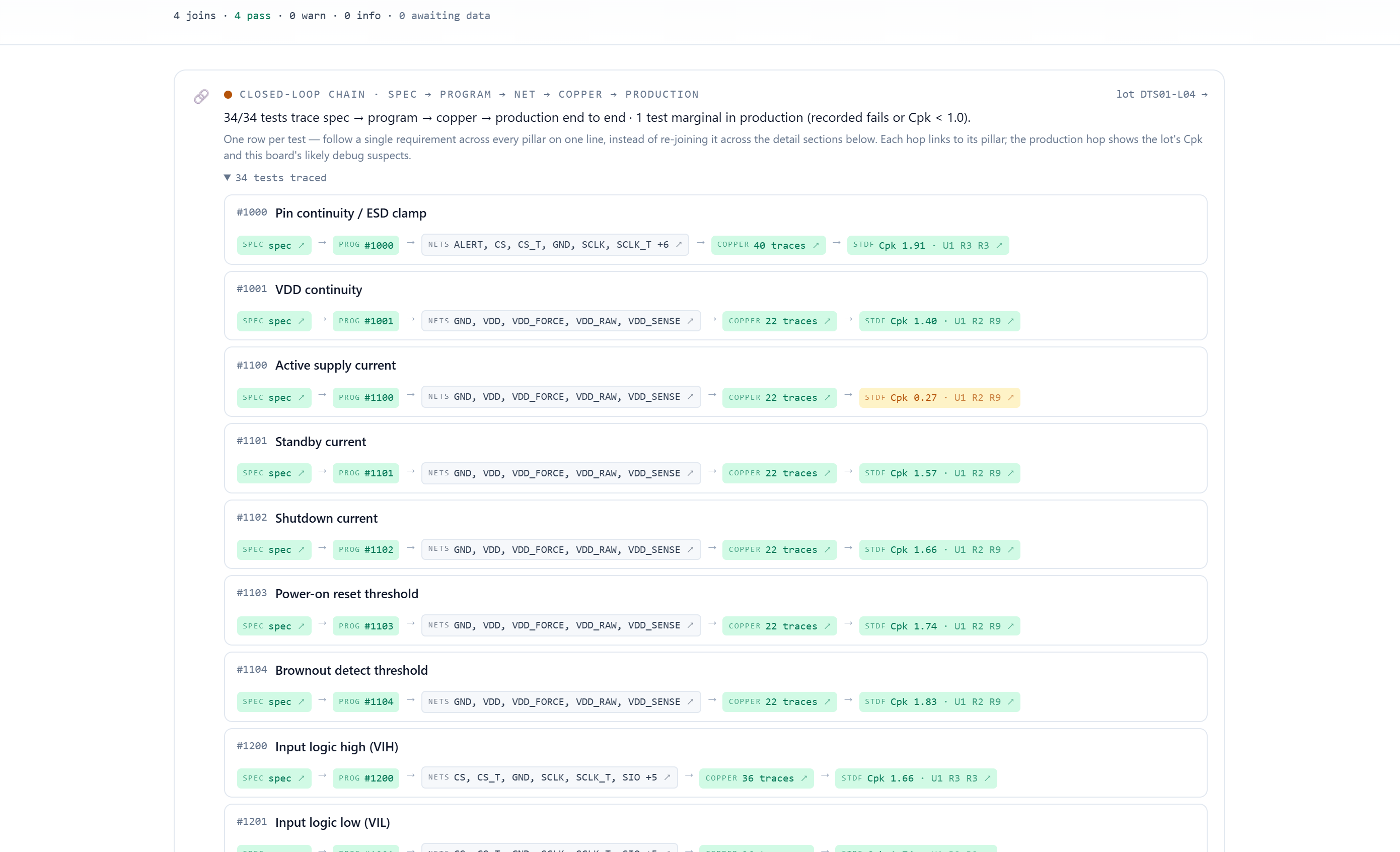
No LLM sits anywhere in this pipeline. Every verdict is reconciled mechanically — same inputs, same answer — so the dashboard and the chat assistant can never disagree with each other.
The joins
Four deterministic joins — reconciled mechanically, so the same inputs always give the same answer. Names are allowed to drift between artefacts; the chain still holds.
| Join | What it catches |
|---|---|
| Spec ↔ Program | Coverage gaps (a requirement no test implements) and limit drift — a program limit looser than the datasheet is a compliance error, attributed to the pillar that owns each number. |
| Program ↔ Board | A program that drives a pin the board does not route, a board pin no test uses, a power rail mapped to a digital channel. |
| Schematic ↔ Copper | A net the schematic declares but no routed copper carries — so a requirement that looks covered on paper is exposed as unreachable on the physical board, tester-side series-termination and Kelvin nets included, disclosed as such. |
| Program ↔ Production | The limits a lot actually ran versus the limits the program has now — historical drift is reported as drift, never mislabelled as a spec violation. |
How it works
Every load reviews the four pillars fresh — the ingested spec, the program
workbook (the dashboard labels which copy it reviewed), the saved board design,
and the production STDF — and reconciles values by what they mean, so
65 uA and 65e-6 A compare as equal.
Attribution is the point: on real
customer data the limit sources legitimately differ, and the difference between
"the lot ran at a recorded limit" and "the program violates the spec" is the
difference between a finding and a false alarm. The joins compose into one row per
test — spec → program → nets → copper → lot Cpk, with debug suspects ranked for any
marginal test — and a missing pillar renders as awaiting data with the
action that unlocks it, never as a silent pass.
Requirement → copper
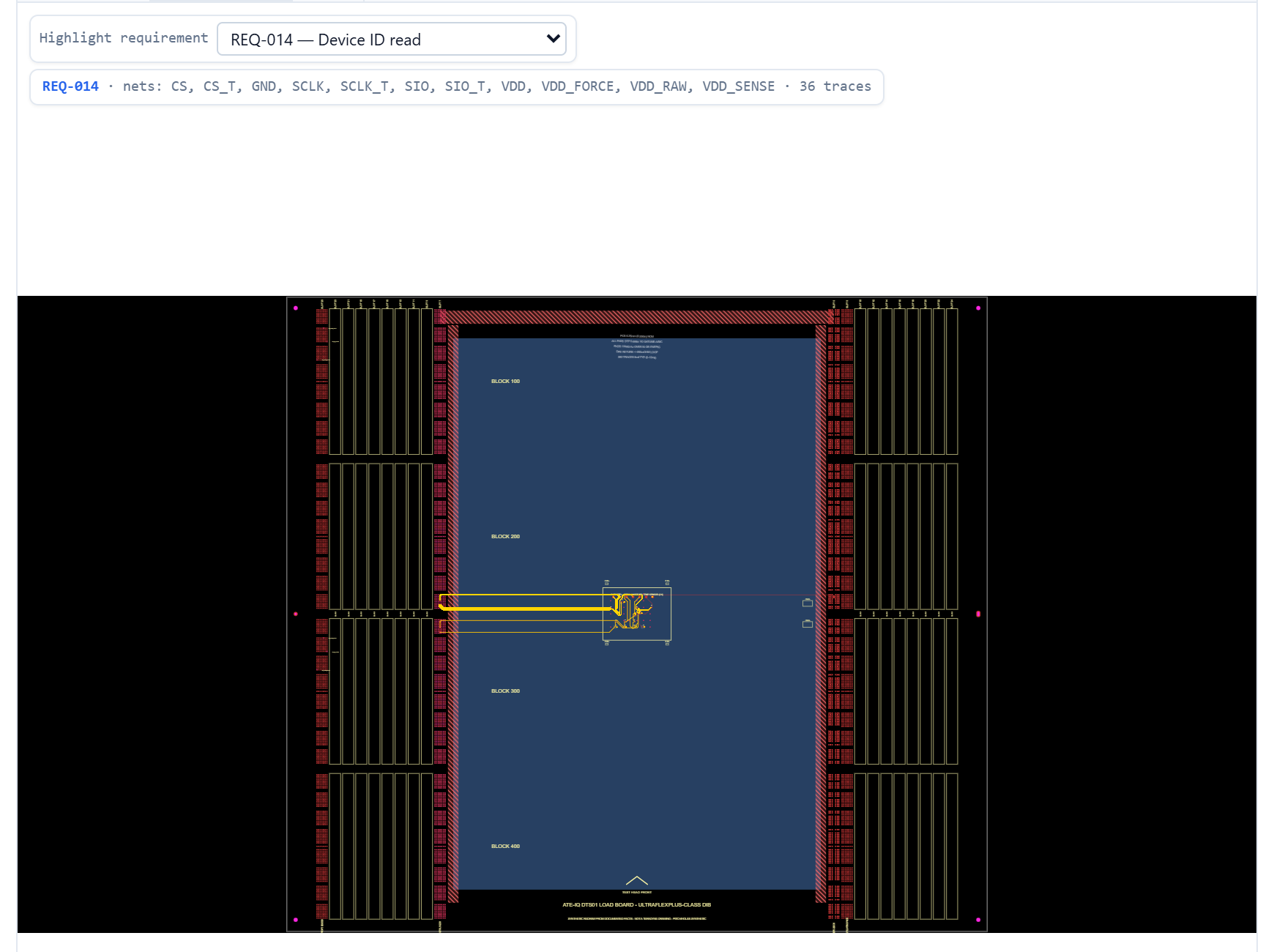
The chain does not stop at the netlist. Select a requirement in the PCB Designer and its nets — including the tester-side series-termination and Kelvin force/sense extensions, disclosed as such — light up on the routed board, aligned with the copper by construction, never by luck.
Proven end to end
The demonstration project closes the loop completely: 34 of 34 tests trace spec → program → copper → production, and all four joins pass. The final-test lot shows test 1100 (active supply current) at Cpk 0.27 — drifting across four lots while wafer sort stays healthy — with the likely board-side suspects (U1, R2, R9) named by the production hop. And the SIO output-level tests, measured at the tester behind a 33 Ω series termination carrying 3 mA — a 99 mV drop the program limits compensate and the test method documents — reconcile as an info-class documented measurement-path compensation, while an undocumented looser-than-spec limit still reports as the error it is.